

If you’re learning English, chances are you’ve been caught in this trap: someone asks you a simple question—“How are you?”—and your brain immediately goes on a detour. First, you hear the words. Then, you translate them into your native language. Next, you think of the answer in your native language. Finally, you translate back into English. By the time you’re ready to reply, the conversation has already moved on. Ouch.
This endless translation cycle is one of the biggest obstacles to fluency. The good news? You don’t have to stay stuck in “translation mode.” With the right strategies, you can train your brain to think directly in English—no detours required. Let’s explore how.

Imagine you’re riding a bicycle. If you have to stop every few seconds, get off, and check a manual before pedaling again, you’ll never pick up speed. That’s what translation does to your English—it interrupts the natural flow of thought.
Translation also has another downside: it makes your English sound less natural. Expressions that work beautifully in your native language may sound strange when translated word for word. For example, in some languages, you might say, “I have hunger,” but in English, it’s simply, “I’m hungry.”
Thinking directly in English helps you:
Speak faster and more confidently
Understand native speakers without overthinking
Sound more natural in conversations
Build fluency without adding extra mental steps
The easiest way to begin thinking in English is to name things around you in English.
When you wake up: bed, blanket, pillow, alarm clock.
When you make breakfast: spoon, milk, coffee, bread.
When you head outside: street, car, bus, sunshine.
This habit trains your brain to connect English words directly to objects, rather than translating from your first language. Over time, it becomes automatic. It may sound simple- but trust me, it works!
👉 Try this: Stick small Post-it notes on common objects in your home with their English names. Yes, it might make your house look like an English museum exhibit, but you’ll reap the rewards!
Once you’re comfortable labeling objects, move to short, simple thoughts in English. Instead of thinking, “I should drink some water” in your first language and then translating, try saying it directly in English inside your head:
I’m thirsty.
I need water.
Time to drink.
The goal is not to create complex sentences right away but to build fluency with everyday thoughts.
👉 Tip: Narrate your actions as you go through your day. “I’m brushing my teeth.” “I’m checking my phone.” “I’m walking to the bus stop.” It feels silly at first, but this practice rewires your brain to use English automatically.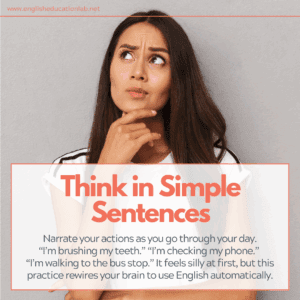
Here’s a powerful trick: connect English words to images, not translations.
For example, when you hear “dog,” don’t let your brain jump to the word in your native language. Instead, picture an actual dog—maybe a big fluffy golden retriever or your neighbor’s barking chihuahua.
This is how children learn languages naturally. They don’t translate; they associate words directly with things, actions, and feelings. You can do the same.
👉 Try this: Use picture-based flashcards (without translations) or apps that focus on visuals. When you learn the word apple, imagine biting into a shiny red apple instead of saying the word in your native language.
One of the best ways to practice thinking in English is to have silent conversations with yourself.
While cooking: “I need more salt. Where is the knife?”
While shopping: “Do I want this shirt in blue or black? Blue looks better.”
While waiting: “Why is this bus so late? Maybe I should walk.”
At first, your sentences may be simple, but with practice, you’ll naturally begin to use more complex structures.
👉 Bonus challenge: Argue with yourself in English. Pick a silly topic like “Is pizza better than pasta?” and debate both sides in your head. You’ll not only think in English—you’ll practice forming opinions, too.
If you want your brain to think in English, you have to feed it English every day. But don’t worry—it doesn’t mean boring textbooks.
Podcasts and audiobooks: Listen to stories or topics you enjoy in English.
TV shows and YouTube: Watch with English subtitles, but try to focus on the meaning, not word-by-word translation.
Music: Sing along to English songs (badly is fine—we all sound like rock stars in the shower!).
The more you immerse yourself in English, the more natural it becomes to think in it.
Many learners get frustrated because they can’t think quickly in English at first. But remember: fluency is like building a muscle—it takes consistent exercise.
Don’t pressure yourself to be perfect. Even if your sentences are short or slightly “broken,” it’s better than pausing to translate. Over time, your brain will fill in the gaps.
Think of it like learning to ride a bike. Wobbling at the start is normal. What matters is that you keep pedaling—in this case, keep thinking in English.

Finally, to truly strengthen the habit of thinking in English, you need to speak it aloud. Find a speaking partner, join an online English class, or even talk to yourself in the mirror.
When you speak regularly, your brain starts preparing responses directly in English rather than translating. The more you practice, the smoother and faster your thoughts will flow.
👉 Quick tip: Record yourself speaking on your phone for one minute each day. Don’t plan—just talk. You’ll be surprised at how quickly your ability to think in English improves.
Learning how to think directly in English is not about being perfect—it’s about reducing your brain’s dependence on translation and building natural fluency. Start small with words and sentences, connect English to images, use daily inner dialogues, and surround yourself with English through media and speaking practice.
Yes, it takes patience, but with consistent effort, you’ll notice a shift. One day, you’ll realize you just had an entire thought in English—without even trying. That’s when you’ll know: you’ve stopped translating and started living in the language!
✨ At English Education Lab, we specialize in helping learners like you build confidence in real communication—whether it’s through conversation practice, online classes, or thought-provoking ESL resources. Ready to make English your everyday language? Let’s get started together! Book your free 20-minute trial lesson by shooting us an email at: info@englisheducationlab.net. We’ll discuss your language learning needs and goals, get to know one another and discuss a learning curriculum made specifically for you!
Subscribe to my YouTube Channel!
Get your FREE cheat sheet on the English articles!
Further Reading
Why do I have a fear of speaking in English and what can I do about it?
Is ESL certification online really worth it? A smart guide for English learners
Skip perfect—Speak like a native English speaker instead
Innovative ESL resources for teachers: Unlocking the power of social media conversations
Top 5 online tools to use as an ESL learner
The question of time: How long does it take to learn English?


