


Have you ever listened to a native English speaker and thought, “How do they speak so smoothly?” Their words flow effortlessly, their rhythm feels natural, and even when they speak quickly, their pronunciation is clear. The good news is—you can train yourself to sound more like that, and one of the most effective ways to do it is through something called the Shadowing Technique.
In this post, we’ll explore what the shadowing technique is, how it helps ESL learners, and how you can start using it today with practical examples and recommended resources, including The English Education Lab Podcast, designed especially for English learners like you.
The Shadowing Technique is a language-learning method where you listen to a native speaker and repeat what they say at the same time—almost like you’re their shadow. Instead of simply listening or repeating after a pause (like in most listening exercises), you’re speaking with the speaker, matching their intonation, rhythm, and pronunciation as closely as possible.
Imagine you’re watching a TED Talk or listening to a podcast. As the speaker talks, you try to speak along in real-time, echoing their speech as accurately as you can. You don’t wait for them to finish—you follow their voice just a beat behind.
It might feel a bit strange at first (and maybe even a little funny), but it’s one of the most powerful tools for improving your spoken English and listening skills at the same time.
Let’s break down exactly how shadowing can take your English to the next level.
When you shadow, you’re not just repeating words—you’re training your mouth muscles to move like a native speaker’s. Every language has its own physical rhythm and mouth movements. Shadowing helps you imitate those movements until they become more natural.
You’ll start noticing subtle details like:
How native speakers connect words together (“gonna,” “wanna”)
Which syllables they stress in a sentence
How their intonation rises and falls naturally
Over time, this imitation turns into habit. You won’t have to “think” about pronunciation—it will simply flow.

Listening and speaking are two sides of the same coin. When you shadow, your brain has to listen carefully to each sound in order to repeat it immediately. This deep listening trains your ear to catch differences between similar sounds (“ship” vs. “sheep,” “live” vs. “leave”) and helps you understand native speakers more easily in real life.
You’ll also become faster at processing English, which means you’ll follow conversations more easily—even when people speak quickly.
If you’ve ever hesitated while speaking English because you were searching for the right words or trying to form correct grammar, shadowing can help. Since you’re constantly speaking while listening, your brain gets used to forming English sentences automatically.
In other words, shadowing helps your mouth and mind work together in real time. The result? You’ll start speaking more quickly, smoothly, and confidently, without overthinking every word.
Many ESL learners feel nervous about speaking English—especially in front of others. Shadowing is a low-pressure way to practise speaking daily without worrying about making mistakes or being judged.
When you do it regularly, you’ll feel more comfortable hearing your own voice in English, and your pronunciation will improve quietly behind the scenes. Then, when you’re in a real conversation, your confidence will naturally shine through.
Shadowing also helps you remember words and phrases better. Because you’re listening, speaking, and reading (if using a transcript) at the same time, you’re using multiple senses, which strengthens memory.
You’ll find yourself naturally using expressions or chunks of language you’ve shadowed before—like “You know what I mean?” or “Let’s get started.” You’re not memorising grammar rules; you’re learning real, functional language.
Ready to give it a try? Here’s a simple plan to get you started.
Pick something with clear audio and natural speech, ideally something that interests you. You can start with short clips (1–3 minutes) and gradually increase the length as you improve.
Good options include:
The English Education Lab Podcast – short, topic-based episodes made for learners who want to improve both listening and speaking skills. Each episode includes clear pronunciation and natural pacing, perfect for shadowing.
TED Talks – inspiring and clear English on almost any topic.
News clips (BBC Learning English, VOA Learning English) – great for clear pronunciation and real-life vocabulary.
Audiobooks – if you want to challenge yourself with longer speech.
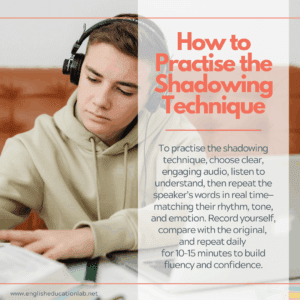
Before you start shadowing, listen once or twice just to understand the meaning. Focus on what is being said, not just how it’s said.
Ask yourself:
What’s the main idea?
Which words are new or difficult to pronounce?
What’s the overall tone or emotion of the speaker?
If you can find a transcript, read along as you listen. This helps you connect spoken and written forms of words and identify where the speaker connects or drops sounds.
If you’re shadowing an episode of The English Education Lab Podcast, you can follow along with the episode summary or transcript if provided.
Now, the fun part!
Play the audio and start repeating what you hear immediately, keeping up as best you can. You might feel like you’re chasing the speaker—and that’s okay. The goal isn’t perfection at first, but synchronisation.
Focus on:
Rhythm (how words are connected)
Intonation (the rise and fall of speech)
Emotion (how tone changes meaning)
If you lose track, pause, rewind, and try again.
This step is incredibly helpful. Use your phone to record a short section of your shadowing practice. Then, play it back and compare your version to the original.
You’ll start noticing:
Where your pronunciation is strong
Where you miss certain sounds or stresses
How close your rhythm matches the native speaker’s
This type of self-feedback accelerates improvement faster than any grammar exercise ever could!
Consistency matters more than perfection.
Try shadowing for 10–15 minutes a day, focusing on one piece of audio at a time. You’ll start to feel real changes within a few weeks—especially in how natural and confident your speech sounds.
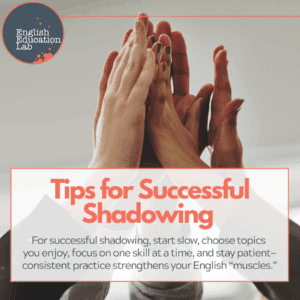
Start slow. Don’t worry if you can’t keep up with fast speakers. You can use tools like YouTube playback speed (0.75x or 0.9x) to slow down the speech slightly until you’re comfortable.
Choose topics you enjoy. It’s easier to stay motivated when the content interests you—podcasts, movies, or interviews you genuinely like.
Focus on one skill at a time. Some days focus on pronunciation; other days, on rhythm or intonation.
Use headphones to hear every detail clearly.
Stay patient. Shadowing is like going to the gym for your English muscles—the more you do it, the stronger your speaking and listening become.
Here are a few trusted resources to help you get started:
If you’re looking for content made especially for ESL learners, this is the perfect place to start.
Each episode focuses on real-life English topics—communication, motivation, success, and everyday life—with clear, natural pronunciation and helpful pacing for learners.
Try shadowing a short section of an episode, then listen again to see how much smoother your pronunciation feels. You’ll also pick up authentic phrases and natural expressions along the way.
Search for short talks under 5 minutes. Choose speakers with clear accents (like Richard St. John’s “Secrets of Success in 8 Words”) and use the transcript to shadow key sections.
These platforms provide short, slow-paced audio clips with transcripts—perfect for beginners or intermediate learners who want to build confidence before moving on to faster speech.
Look for English-learning channels where native speakers discuss everyday topics. Turn on subtitles, shadow, and gradually turn them off as you improve.
The shadowing technique is one of the most underrated yet effective ways to improve your English. It combines listening, speaking, and pronunciation practice into one simple routine—and it’s something you can do anytime, anywhere.
Whether you’re on a walk, driving to work, or taking a coffee break, all you need is your phone, your headphones, and a few minutes to practise.
At first, it might feel awkward—like singing karaoke in a language you’re still learning—but the results are worth it. You’ll start to hear yourself speaking English more naturally, confidently, and fluently.
So go ahead—pick a short podcast episode, press play, and start shadowing. You might be surprised how quickly your English begins to shine.
Ready to put the Shadowing Technique into action?
Tune in to The English Education Lab Podcast, where each episode helps you practise real-world English listening and speaking in a relaxed, learner-friendly way.
Find it at www.englisheducationlab.net — and start shadowing your way to fluent English today!
Subscribe to my YouTube Channel!
Get your FREE cheat sheet on the English articles!
Further Reading
Why do I have a fear of speaking in English and what can I do about it?
Stop translating: How to think directly in English!
Is ESL certification online really worth it? A smart guide for English learners
Skip perfect—Speak like a native English speaker instead
Top 5 online tools to use as an ESL learner
The question of time: How long does it take to learn English?


