

If you’ve ever dreamed of speaking English smoothly—without awkward pauses, nervous fillers, or that “Did I just say that right?” feeling—you’re not alone. Many English learners set out on their language journey with one big goal: fluency. But what exactly does it mean to be fluent, and can a virtual ESL class truly help you get there?

Spoiler alert: Yes, it can. In fact, your online English class might just be your secret superpower for becoming a confident communicator. Let’s dive into why.
When most learners think of fluency, they picture sounding like a native speaker from a Hollywood movie. But in reality, fluency isn’t about perfection—it’s about communication.
Fluency means:
You can express your thoughts without too many pauses.
You can understand and respond in real-time.
You can carry a conversation naturally (even if you make small mistakes).
Think about it: native speakers make grammar mistakes all the time, but they keep talking. That’s fluency.
So, can your virtual ESL class help you build this kind of fluency? Absolutely—and here’s how.
Let’s face it: language fluency is a muscle. The more you use it, the stronger it gets. A virtual ESL class gives you regular opportunities to flex that muscle—without the hassle of commuting, finding parking, or rushing through traffic.
Bonus: you can literally improve your English while wearing pajamas. Try doing that in a traditional classroom (though we don’t recommend it)!
Language apps are fun, but let’s be honest: when was the last time Duolingo asked you about your weekend plans or debated the best pizza topping?
A virtual ESL class connects you with real teachers and classmates, which means you practice authentic, unscripted conversations. This is fluency gold because:
You learn how to react in real time.
You practice listening to different accents.
You discover how to survive the occasional awkward silence.

Here’s the secret sauce: feedback. When you mispronounce “beach” (you know what I mean), your teacher can gently correct you before it becomes a habit.
This immediate correction helps you:
Notice mistakes you didn’t realize you were making.
Learn alternative ways to say the same thing.
Gain confidence that you’re actually improving.
In other words, your teacher becomes your personal GPS—rerouting you every time you get lost in the English language jungle.
In a virtual ESL class, the focus isn’t just on textbooks—it’s on interaction. Many teachers (myself included) design activities that are specifically built to get you talking.
Some fluency boosters you might encounter include:
Role plays (ordering food, job interviews, small talk at parties).
Debates (yes, arguing politely can actually improve your English).
Storytelling (sharing embarrassing childhood stories is optional, but effective).
Speed speaking (like speed dating, but with less pressure and more vocabulary).
Each activity pushes you to think quickly, respond naturally, and stretch your language muscles in real-life situations.
One of the biggest barriers to fluency is the dreaded “word block”—that moment when you know the word in your native language but it vanishes in English.
In a virtual ESL class, teachers often introduce new vocabulary in context, so it sticks in your brain better. For example, instead of memorizing the word “persuade,” you might practice it in a debate about whether pineapple belongs on pizza. (Answer: it depends who you ask.)
When words are tied to meaningful conversations, you remember them faster and use them more naturally.
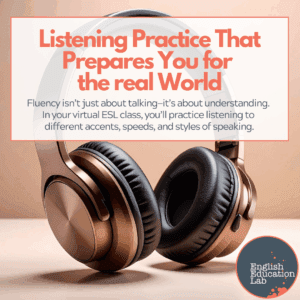
Fluency isn’t just about talking—it’s about understanding. In your virtual ESL class, you’ll practice listening to different accents, speeds, and styles of speaking. This is crucial because:
Real conversations aren’t slow or robotic.
People use slang, idioms, and jokes.
You often have to respond quickly, even if you don’t catch every single word.
Think of it like training your ears at the English gym. The more you practice, the easier it becomes to “catch” meaning in real time.
Here’s the truth: even if you know thousands of English words, you won’t sound fluent if you’re too nervous to use them. Confidence is the secret ingredient.
A virtual ESL class gives you a safe space to make mistakes, laugh about them, and try again. And every time you speak up—even if your grammar isn’t perfect—you build the courage to keep going.
Over time, that nervous little voice that says “Don’t speak, you’ll mess it up!” gets quieter, while your confident voice gets louder. That’s when fluency starts to shine.
Want to accelerate your fluency journey? Here are some practical tips:
Record yourself speaking – Listen back to spot areas for improvement. (Warning: you may cringe the first time, but it gets better.)
Prepare questions before class – This way you never run out of things to say.
Use your camera – Facial expressions and body language are part of natural communication.
Review class notes immediately – Reinforce what you learned before it fades.
Practice outside of class – Talk to yourself, your pet, or even your toaster. The more you practice, the smoother you’ll sound.
Don’t fear mistakes – They’re proof that you’re actually trying.
So, can a virtual ESL class really help you sound more fluent? The answer is a resounding yes. With consistent practice, real conversations, immediate feedback, and confidence-building activities, online learning is one of the most effective (and convenient) ways to improve your English.
Remember, fluency isn’t about speaking without mistakes—it’s about speaking without fear. And with each virtual lesson, you’re one step closer to sounding natural, confident, and fluent.
So, grab your laptop, log into your next class, and get ready to impress the world with your English skills—pajamas optional.
✅ If you’re ready to experience how a virtual ESL class can help you become fluent, check out the courses at English Education Lab. Our lessons are designed to build confidence, fluency, and real-world communication skills for learners at every level.
Subscribe to my YouTube Channel!
Get your FREE cheat sheet on the English articles!
Further Reading
Why do I have a fear of speaking in English and what can I do about it?
Is ESL certification online really worth it? A smart guide for English learners
Skip perfect—Speak like a native English speaker instead
Innovative ESL resources for teachers: Unlocking the power of social media conversations
Top 5 online tools to use as an ESL learner
The question of time: How long does it take to learn English?


